
Almanac
Guides
Read craft first. Exposure in noon sun decides whether a face is readable. Wind on a lake path decides whether the voice survives. The land manager’s permit page decides whether the take is legal. Cameras and the uplink come after those three. Fees, insurance, and drone rules stay on the live city and state pages the day you look.
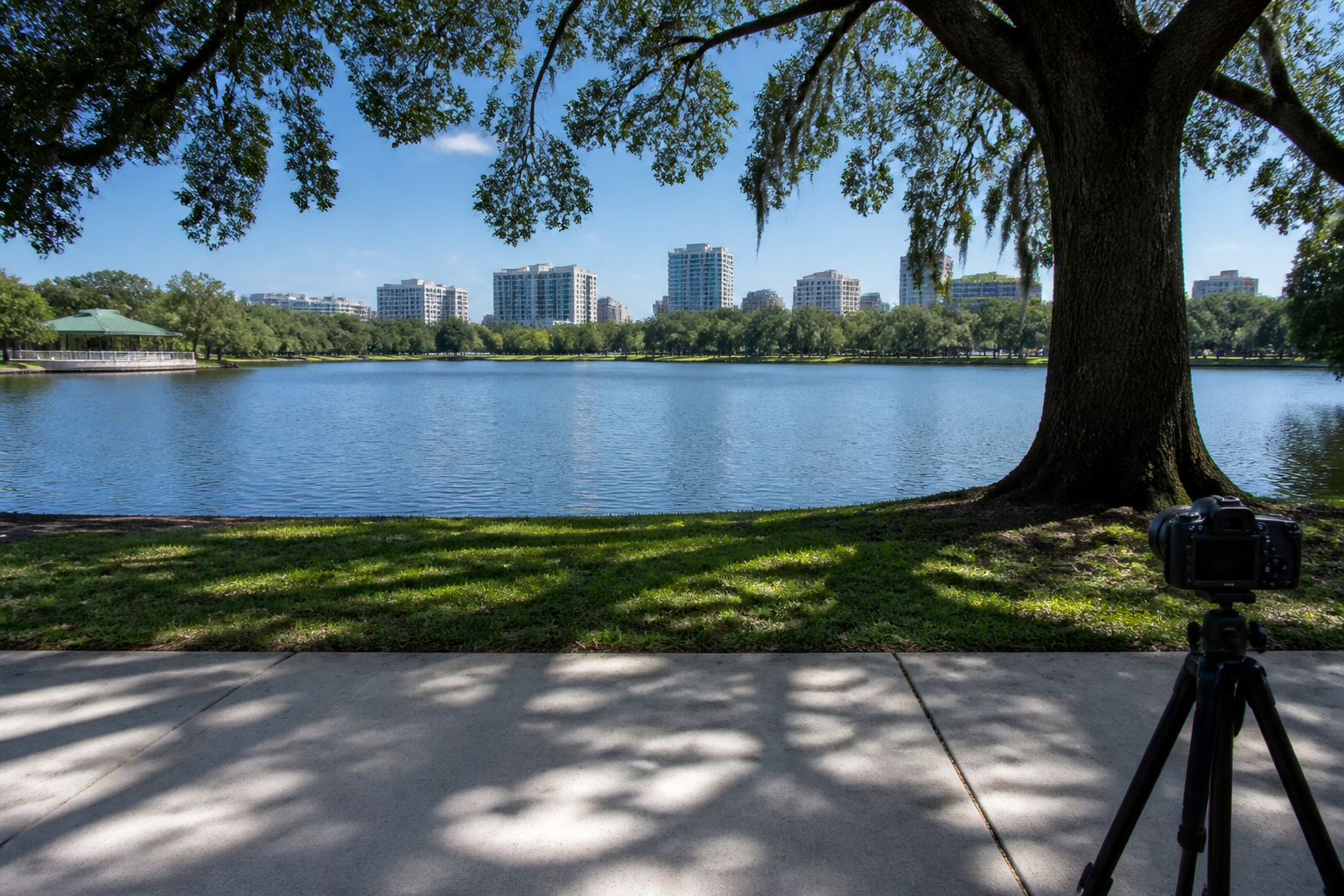
Florida daylight is a hard overhead key. At 24 frames per second a 180-degree shutter is 1/48 of a second — 1/50 on some bodies — and noon will try to push you faster unless a variable ND is already on the lens. A polarizer is a different filter: it cuts glare on water. White balance at 5600 K unless the room is tungsten. Get this when the iris is already as closed as you want it and the face is still clipping.
A shotgun with foam only is still naked in Florida wind. Foam is an indoor plosive cap. Fur goes on next, then you move the capsule out of the gust, then a high-pass if the rumble is still wind. Get this before the encoder starts.
A live take on city property is a land-manager question. Open the City of Orlando Office of Special Events page — the city door that names film productions. The Florida Film Commission (floridafilm.com) posts statewide contacts and notice windows. Confirm fees on those pages. Fees stay on those pages.
Heat is the number printed on the camera spec sheet. Canon, Sony, and Panasonic publish operating-temperature ranges. Condensation is the walk from air-conditioning into wet air: bag the body, wait, then take the cap off. If the sidewalk is already over the temperature printed on the body, the take waits. The live hop — RTMP/S, Ethernet, Wi-Fi, bonded cellular — is a separate lesson.
Parks
How to shoot the parks
Noon, polarizer vs ND, wind on water, AC-to-lake fog. Lake Eola sidewalk and Bill Frederick as craft.
Cameras
Cameras and live-stream kits
Phone, mirrorless, cinema. A real table. HDMI, Ninja, bonded searches.
Uplink
Wireless and internet
RTMP/S. Ethernet vs Wi-Fi vs bonded. Named Orlando pipes — read the plan page.
Exposure
Live video craft in Orlando
Noon sun is the key; ND and 5600 K keep the shutter and the colour. Wind, then heat, in that order.
Permits
Where you may shoot
City film door and the Florida Film Commission. Confirm fees on the live page.
How-to
How to structure a local vlog
Five takes: establish, detail, talk, cutaway, outro. Bitrate tables from YouTube Help.
Literacy
Places to film
City park rules, Film Commission notice windows, state-park photography FAQ — cited, not guessed.
Shop
Shop
ND for noon, fur for wind, spare batteries, a sealed bag. Named by function, cited to makers.
Compare
Compare
Sun, bounce, or daylight LED. A table of control, colour, heat, and power for outdoor faces.
Spec sheet
Spec sheet
How to read a lighting spec. CCT, CRI, TLCI, lux at 1 m, operating temperature. Walked through the LS 60d page.