
Streams
Streams
Live video craft in Orlando. Central Florida daylight is high, hard, and close to 5600K — the same correlated colour temperature daylight LEDs are built to match. Outdoor audio fails first on wind, then on distance. Kit fails on heat and on the jump from air-conditioning into wet air. The numbers below come from maker pages and climate normals, then turn into a field order you can run before a live take.
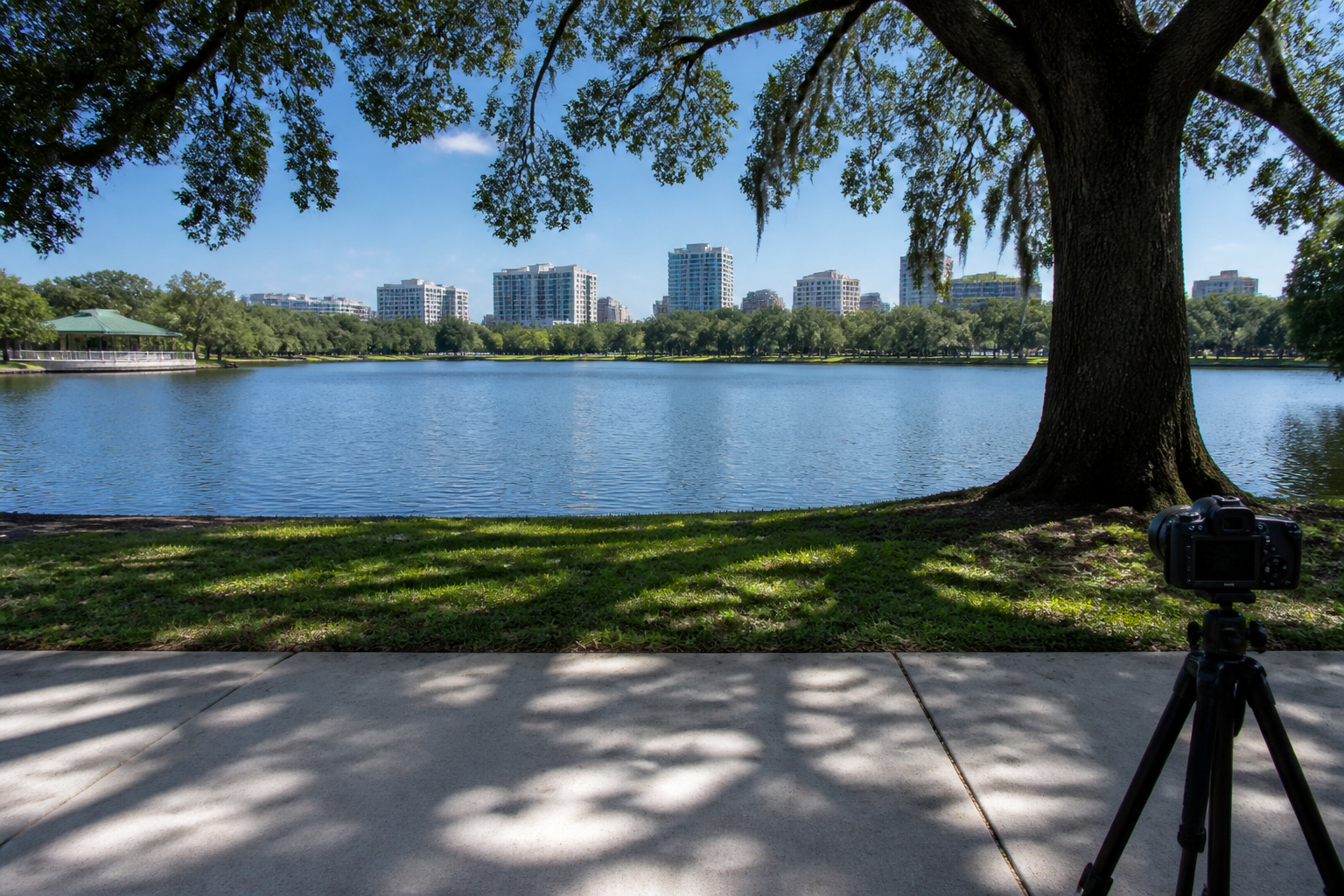
Florida daylight as the key light
A key light is the primary source that shapes a face. Outdoors at solar noon in Orlando, that source is the sun: overhead, specular on pavement, and strong enough that a small LED is fill, not the key. Aputure’s LS 60d is a 60-watt daylight-balanced focusing LED listed at 5600K, CRI ≥96, TLCI ≥98. In spot (15°) the published photometrics are 54,300 lux at 1 metre, 7,602 lux at 3 metres, 2,715 lux at 5 metres. Output falls fast with distance. The table is the inverse-square law in lux, not a slogan.
Use that table two ways. First, match colour: set white balance near 5600K so a daylight LED and open shade do not fight. Second, treat noon sun as many stops above a 60-watt head; a variable ND on the lens, open shade, or a bounce is how a face stays below clipping while the park behind it still reads.
| Beam | 1 m | 3 m | 5 m |
|---|---|---|---|
| Spot 15° | 54,300 lux | 7,602 lux | 2,715 lux |
| Flood 45° | 9,014 lux | 1,096 lux | 402 lux |
Source: Aputure LS 60d product page. Operating temperature on the same sheet: −20°C to 45°C (−4°F to 113°F).
The LS 60d Daylight LED continues Aputure’s ambition to provide high-quality, color-accurate LEDs to all filmmakers, with CRI/TLCI scores of 95+ and an SSI (D56) of 72.
Aputure, LS 60d
Outdoor audio: wind first
A camera-mounted shotgun hears wind as low-frequency roar long before it hears a voice at three metres. RØDE’s DeadCat is “a high-performance windshield for the RØDE VideoMic,” “designed for use in windy recording environments,” with “high-quality artificial fur that is acoustically transparent.” The foam that ships on many shotguns is a pop filter. Fur is the outdoor layer.
Place the mic. A lavalier under a shirt, or a wireless transmitter at the collar, beats a shotgun on a camera five metres back on a Lake Eola path. Keep the recorder out of direct sun. Plastic bodies sit in the same heat that cameras warn about.
Source: RØDE DeadCat.
Heat, humidity, and condensation
The Florida Climate Center reprints NOAA 1991 to 2020 normals for Orlando International Airport: mean daily maximum 92.0°F in July and 91.6°F in August; June precipitation 8.05 inches; July 7.46 inches; August 7.69 inches; annual precipitation 51.45 inches. June through September is the wet season on those totals.
Sony’s interchangeable-lens camera precautions put the designed operating window at 0°C to 40°C (32°F to 104°F) and say shooting beyond that range is not recommended. The same guide: do not use or store the camera “in an extremely hot, cold or humid place,” including “a car parked in the sun.” On moisture condensation, Sony’s live-view remote help is explicit: moisture may condense “when you bring the unit from an air conditioned car or room into a hot place outside.” The remedy they print is a sealed bag until the kit reaches ambient temperature. About an hour in their wording. Then wait if condensation has already formed.
Aputure’s LS 60d lists a wider lamp-head window (−4°F to 113°F). Batteries and recorders often follow the tighter camera band. Shade the body, rotate batteries, and treat the AC-to-parking-lot walk as a condensation event every summer afternoon.
| Month | Mean max °F | Precip inches |
|---|---|---|
| May | 88.4 | 4.02 |
| June | 90.8 | 8.05 |
| July | 92.0 | 7.46 |
| August | 91.6 | 7.69 |
| September | 89.6 | 6.37 |
Source: Florida Climate Center, Orlando 1991 to 2020 normals (NOAA). Kit: Sony Help Guide, Precautions; Sony, On moisture condensation.
Field order of operations
-
Read the sky and the clock
Before 9 a.m. And after 4 p.m. The key drops and faces shape. Midday wants shade, bounce, or ND. Check the afternoon storm on the NWS Melbourne climate desk if the wet season is in.
-
White-balance to daylight
Set around 5600K, or take a custom balance in the shade you will actually stand in. Mix a daylight LED only after the camera and the sun agree.
-
Mic before picture
Fur on the shotgun, or a lav on the talent. A five-second clap at the distance you will talk from is the check. If wind eats it, the live take will too.
-
Acclimate the kit
Sealed bag from the car AC to the park. Sony’s condensation note is the reason. Then confirm the body is inside the 32 to 104°F window they print.
-
Encode for the pipe
YouTube Help’s live encoder table recommends H.264 at 10 Mbps for 1080p30 ingest, CBR, keyframes every 2 seconds. Uploads use a different table. 8 Mbps for 1080p at 24 to 30 fps. Match the path you are actually on. Details on the vlog structure lesson.
Local live signals
Stations and civic streams publish on their own pages. Open those URLs for the clock.
| Source | Page |
|---|---|
| WESH 2 | wesh.com |
| WFTV Channel 9 | wftv.com |
| FOX 35 Orlando | fox35orlando.com |
| WKMG ClickOrlando | clickorlando.com |
| Spectrum News 13 | mynews13.com/fl/orlando |
| Watch Council Online | orlando.gov |
| Orange TV Live | orangecountyfl.net |
FAQ
- Why 5600K and not auto white balance?
- Auto hunts when clouds move. Aputure lists the LS 60d at 5600K so a locked daylight balance stays consistent from take to take.
- Is 113°F on the light the same as the camera?
- No. Aputure’s LS 60d lists −4°F to 113°F. Sony’s precautions for the cameras in that help guide list 32°F to 104°F. Follow the tighter window for the body and batteries.
- Where do park rules live?
- Craft on how to shoot the parks. Literacy on places to film, with links to the city, Film Commission, and Florida State Parks.